
Introduction
Agriculture significantly impacts climate change, primarily due to substantial greenhouse gas emissions like methane and nitrous oxide. The global objective of achieving net-zero emissions – balancing emitted and removed greenhouse gases – presents a crucial challenge for the sector. This article delves into agricultural emissions worldwide, with a particular emphasis on Southeast Asia, regions critical to global agriculture. It will assess the progress towards reducing emissions and highlight successful strategies from Asia, providing essential insights for businesses and stakeholders in agriculture to align practices with environmental sustainability.
A Statistical Overview
Over the past decade, the global agricultural sector has seen a steady rise in greenhouse gas (GHG) emissions, indicating an increasing environmental impact. This trend, reflected in millions of metric tons of carbon dioxide equivalent, highlights the urgent need for focused emission reduction strategies in agriculture. The primary GHGs from this sector are methane, released mainly through livestock digestion, and nitrous oxide, predominantly emitted from the use of synthetic and organic fertilizers.
Agriculture’s role in global emissions is significant. As per the International Energy Agency (IEA) and the Food and Agriculture Organization (FAO), it accounts for about a quarter of the world’s total GHG emissions, contrasting with other major sectors like energy, industry, and transport. This underlines the importance of addressing agricultural emissions in global climate change efforts.
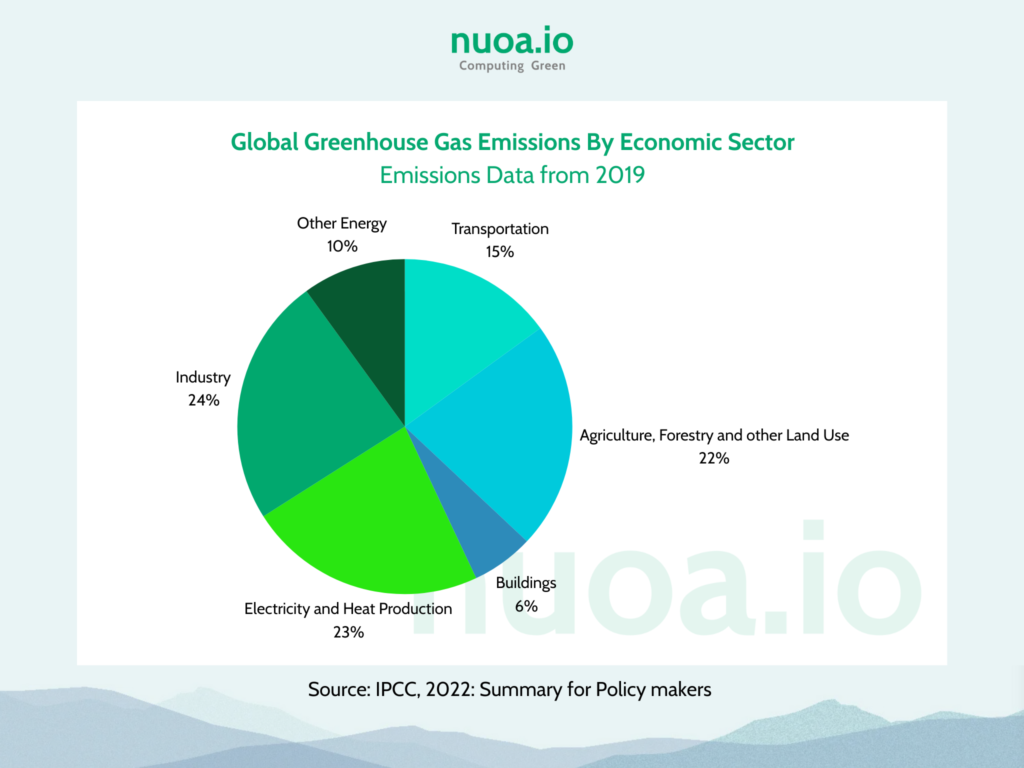
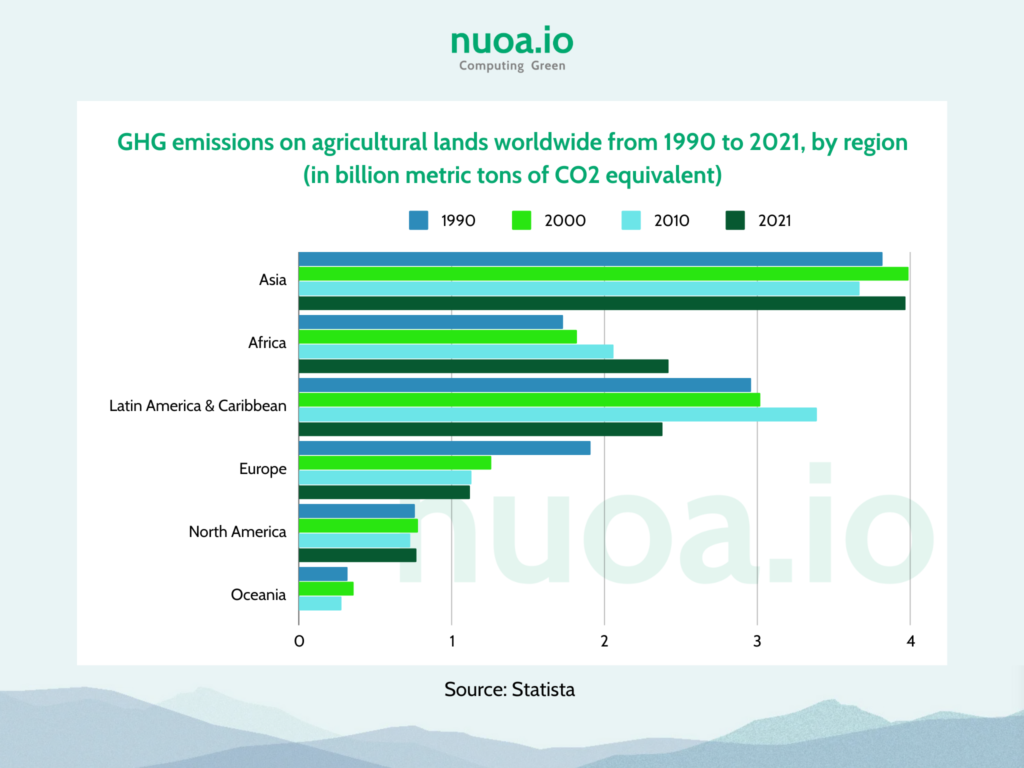
In Asia, agricultural emissions mirror the global upward trend, with the region consistently showing high emission levels due to extensive farming activities, compared to other regions in the world. The growth of the sector in these regions, vital for their economies and food security, brings substantial environmental challenges. The diverse agricultural practices in Asia, ranging from small-scale farming to large-scale commercial agriculture, require unique approaches to manage emissions effectively. Understanding the varied farming landscapes and socio-economic contexts is crucial in formulating strategies to reduce GHG emissions in these regions.
Impact of Natural Disasters and Climate Change on Agriculture
Natural disasters have significantly impacted agriculture, particularly in Asia, leading to notable financial and production losses. According to the Food and Agriculture Organization of the United Nations (FAO), between 1991 and 2021, natural disasters globally caused around $3.8 trillion in production losses in crops and livestock. In regions like Asia, where agriculture is a key livelihood, these disasters – including floods, droughts, and storms – have led to extensive crop and livestock damage, exacerbating economic challenges and threatening food security.
The relationship between climate change and agricultural vulnerability is increasingly critical. Climate change intensifies the severity and frequency of natural disasters, further endangering an already vulnerable sector. This trend necessitates the adoption of resilient and sustainable agricultural practices. Strategies like crop diversification, improved water management, and the use of climate-resilient technologies are essential to mitigate the adverse effects of these environmental changes, ensuring the sustainability and economic stability of agriculture-dependent regions.
Decarbonizing Agriculture: Global Trends and Regional Initiatives
In the context of agricultural emissions reduction, specific sectors such as rice cultivation, industrial crop cultivation, livestock farming, and milk production each contribute uniquely to greenhouse gas emissions and require tailored initiatives to address them effectively.
Rice cultivation, a significant methane emitter due to flooded paddies, is being targeted for emissions reduction through initiatives like the Gold Standard’s new methodology. In Vietnam, the “Fertilize Right” project, backed by a $4.4 million grant, aims to modernize rice farming and cut emissions by promoting smarter fertilizer use. Likewise, industrial crop cultivation contributes to emissions primarily through land use change and chemical inputs, necessitating sustainable practices like deforestation reduction and organic farming. Livestock farming, another major emitter, is being addressed through improved resource efficiency, better grazing management, and integration into circular economies, aligning with Nationally Determined Contributions. Similarly, emissions from milk production are being tackled through measures such as enhancing feed efficiency, utilizing methane-reducing additives, and implementing effective waste management practices.
In Asia and Southeast Asia, where agriculture is a cornerstone of many economies, regional efforts align with global initiatives like the Paris Agreement and the Sustainable Development Goals. Governments in these regions are implementing policies and participating in international collaborations to address agricultural emissions, with organizations like ASEAN spearheading various programs focused on sustainable agriculture in the context of climate change.
Furthermore, technological innovation plays a crucial role in achieving net-zero emissions in agriculture. Advances in precision farming and the use of modern technologies like satellite imagery and AI enhance resource management, reduce emissions, and enable more informed decision-making for sustainable agricultural practices. These innovations are vital for ensuring the long-term sustainability of agricultural systems in the face of climate change.
Business goals
Developing a greenhouse gas (GHG) inventory is a significant undertaking for corporates, requiring clear goals to manage their GHG emissions effectively. To achieve this, corporates should understand how inventories can help them meet these goals.
Typically, corporates aim for GHG inventories that serve multiple purposes, including tracking and reducing GHG impacts, setting reduction targets, understanding operational and reputational risks, and reporting to stakeholders and government agencies. Many agri-food corporates, out of the 4,535 engaged with SBTi, are mapping Scope 3 emissions and setting science-based net-zero targets. Among them, 176 have committed to net-zero emissions, with a combined annual revenue of nearly $500 billion. They’re reducing GHG emissions by identifying emission hotspots and implementing measures like carbon avoidance and neutralization in their supply chains. The table below highlights net-zero commitments and focus areas of some corporates.
Conclusion
The exploration of emissions within the agricultural sector and the global quest for net-zero reveals a sector pivotal to environmental health and sustainability. The upward trend in greenhouse gas emissions, particularly methane and nitrous oxide, from agricultural activities globally and in regions like Asia, calls for urgent and innovative emission reduction strategies. Asian case studies highlight successful approaches in sustainable irrigation, organic farming, and livestock management, demonstrating that environmental sustainability can be synergistic with agricultural productivity.
Global and regional initiatives, including the Paris Agreement and UN Sustainable Development Goals, provide a crucial framework for this transformation. Equally important is the role of businesses in the agricultural sector in adopting sustainable practices, renewable energy, and efficient resource management. Achieving net-zero emissions in agriculture is a multifaceted challenge that necessitates collaborative efforts from governments, businesses, and individuals, offering a unique opportunity to reshape our environmental impact and foster a sustainable future.
Lead Author:

Hieu Dinhin
Email: hieu.dinh@nuoa.ioMr. Hieu Dinh is a senior business leader with experience across multiple industries. His past experience included development policy consulting, circular economy investments and corporate actions. He earned his MBA from INSEAD, which is globally reputable for sustainable business and innovation. Hieu completed Bachelor of Economics and Finance with High Distinction at RMIT University under full scholarship.