
Introduction
GHG accounting and reporting is necessary and burdensome as every path equal to more prospective and common compliance schemes in business and market. At Nuoa.io, we provide solutions and services to help businesses measure, manage, report and disclose their GHG emissions.
An irreversible trend
GHG accounting is a mandatory requirement for several emitting sectors across the world and has become a global trend. In recent years, more than 30 countries have announced climate disclosure regulations, and many markets are moving from voluntary reporting into mandatory compliance.
The European Union's policies and global market requirements have already influenced Vietnamese exporters. Businesses that wait until regulations arrive may face rushed data collection, higher costs, and weaker negotiating power with buyers and partners.
In Vietnam, Decree 06/2022/ND-CP and Decision No. 01/2022/QD-TTg are important signals for businesses. The regulations require entities in relevant sectors to submit greenhouse gas inventory reports and develop plans for GHG emission reduction.
A must-have strategy for growth
In the middle of global climate action, carbon disclosure has become a passport for companies seeking to grow across supply chains. Businesses that understand their emissions can better control cost, identify operational inefficiencies, and make credible commitments to partners.
Secondly, carbon reduction can become a momentum for innovation. When firms examine energy use, production processes, logistics, and procurement through a carbon lens, they often find opportunities to reduce waste and improve resilience.
Ultimately, GHG accounting and reporting can help businesses move from defensive compliance to proactive strategy. Those who prepare early can respond to requests from customers, regulators, and investors with verified information instead of fragmented spreadsheets.
Accounting for GHG emissions is not an easy task.
Despite the need for better carbon accounting, the process can be challenging due to implementation and application. It requires an understanding of emission scopes, data sources, emission factors, organizational boundaries, and reporting standards.
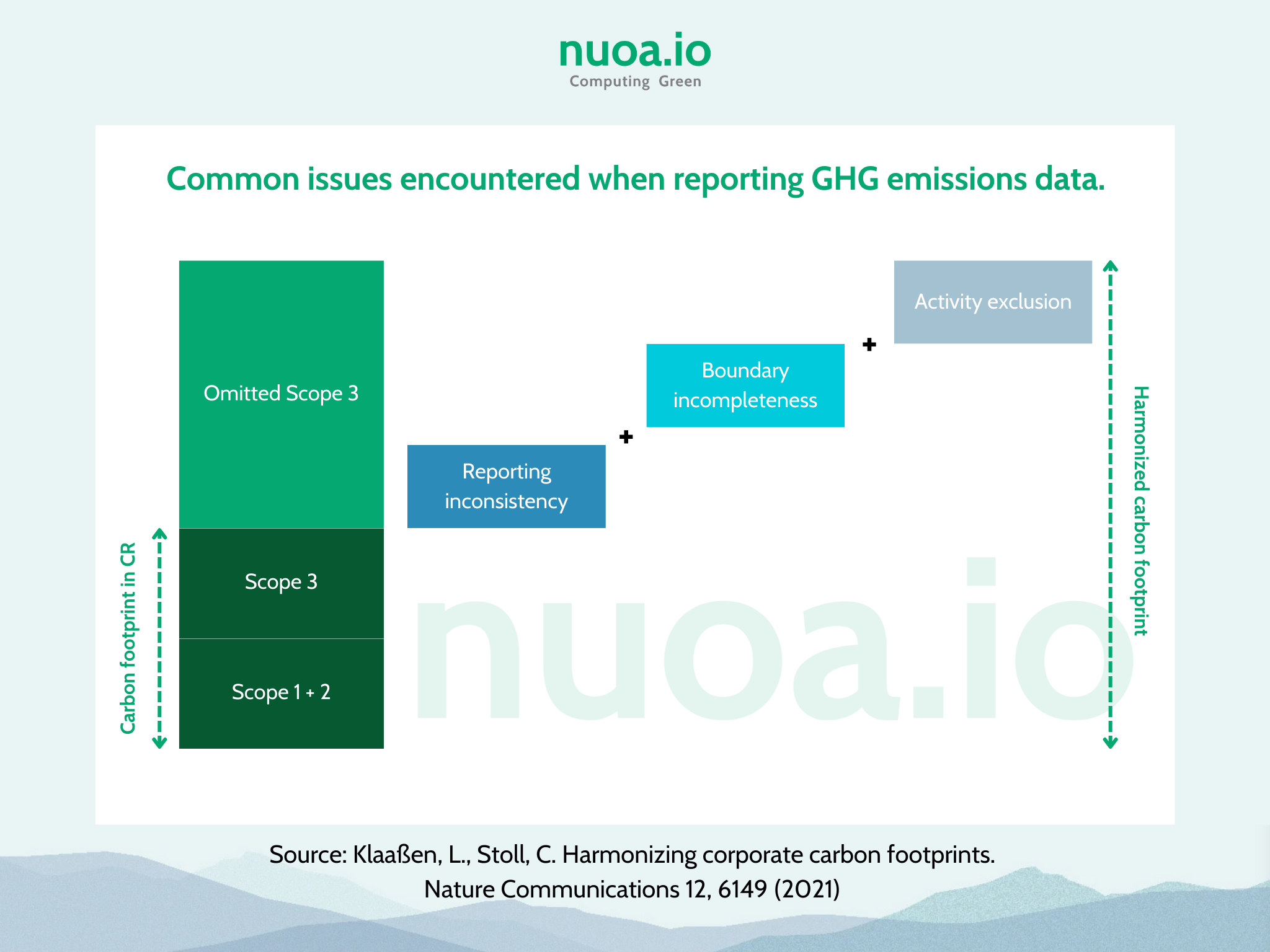
Enterprises commonly encounter issues such as mismatched data, missing supplier information, insufficient internal ownership, and confusion between product-level and organization-level accounting. Without a reliable system, reporting becomes time-consuming and difficult to audit.
Digital transformation is a prerequisite for overcoming these obstacles. Carbon management software helps reduce the workload of data collection, calculation, reporting, and analysis, enabling organizations to manage carbon emissions efficiently, ensure technical compliance, identify mitigation opportunities, and reduce costs. Just as Generative AI has eliminated bottlenecks for Photoshop experts in image creation, carbon management software like Nuoa.io eliminates bottlenecks related to the scarcity of carbon accounting experts, allowing companies to adopt the latest implementation methods without the need for extensive training and retraining of sustainability developers when methodological changes occur.
However, an effective carbon management tool requires a combination of deep expertise in ICT (Information and Communication Technology) and specialized knowledge in environmental economics and environmental science. Additionally, as global standards and frameworks are still evolving, companies should seek suppliers with the resources and research capabilities to continuously update the latest developments.
Finally, these tools will actively support sustainability development managers in minimizing carbon emissions within the company. These tools can provide detailed information for planning potential carbon reduction methods, a necessary step post-audit.
Authors

Hieu Dinhin
Email: hieu.dinh@nuoa.ioMr. Hieu Dinh is a senior business leader with experience across multiple industries. His past experience included development policy consulting, circular economy investments and corporate actions. He earned his MBA from INSEAD, which is globally reputable for sustainable business and innovation. Hieu completed Bachelor of Economics and Finance with High Distinction at RMIT University under full scholarship.

Nguyễn Ngọc Lanin
Email: lan.nguyen@nuoa.ioMs. Lan Nguyen does her PhD research in Economics, Environment, Evolution, and Ecology at the prestigious Dartmouth College (USA). Her research focuses on green growth policy, natural resource management, and environment policy and ecology.